At Westfield Century City Shopping Center in California, Harper Mance, 31, said: “I’m looking around, thinking, ‘If there are discounts on everything now, what’s it going to be like after Christmas?’ You know it’s going to go down further.”
Showing posts with label Macroeconomics. Show all posts
Showing posts with label Macroeconomics. Show all posts
Sunday, November 30, 2008
Deflation is in the minds of customers, just like Inflation
The New York Times story on Black Friday sales has this quote from a non-shopper,


Tuesday, July 22, 2008
What happened to all the speculators driving up oil prices?
Speculators were an easy target for the Congress that wanted to show the people that they are doing something about the oil prices. A simple explanation of demand and supply was not enough, it was too complex for most to comprehend.
Every story needs a villain, a damsel in distress and a knight in shining armor. Arguably, the speculator are the real knights but they are not up for reelection nor are they good at pitching their side. So the lawmakers took the opportunity to pitch the plausible story of oil speculators driving up prices.
But as the demand fell due to consumers adjusting their behavior, the oil prices fell back 13% from its highs. The Nightly Business Report's Suzanne Pratt said this nicely:
Of course there is enough room in this for lawmakers to tell a different story, the mere mention of curbing speculation was enough to slay the dragon.
Every story needs a villain, a damsel in distress and a knight in shining armor. Arguably, the speculator are the real knights but they are not up for reelection nor are they good at pitching their side. So the lawmakers took the opportunity to pitch the plausible story of oil speculators driving up prices.
But as the demand fell due to consumers adjusting their behavior, the oil prices fell back 13% from its highs. The Nightly Business Report's Suzanne Pratt said this nicely:
PRATT: So what happened to all the speculators that were supposedly driving up prices and ignoring fundamentals? Today, futures regulators said an inter-agency task force has found that supply-demand fundamentals are the best explanation for the recent run-up in oil prices, not excessive speculation, as some lawmakers believe. Many economists and analysts agree that fundamentals, mostly strong demand from India and China, have been the primary price driver, as well as stagnant supplies. But those fundamentals may be changing. Economist Carey Leahy says investors are waking up to the idea that slowing U.S. growth and other global factors could result in a big drop in demand.
Of course there is enough room in this for lawmakers to tell a different story, the mere mention of curbing speculation was enough to slay the dragon.
Saturday, July 19, 2008
NYTimes Reports Increase in Online Shopping
Greg Manikw, the author of my favorite Macroeconomics book, writes in his blog a series on Cross-Price Elasticity of Demand.
The New York Times reports that shoppers are doing more online shopping than driving to the stores. While the demand for the products has not shifted to their substitutions, the channels through which people buy has.
Down the line this means drop in incentives to the employees who work in the shops and it is bound to cause shift in their consuming patterns.
If I can make predictions about other economic and consumer behavior changes we should expect in the future, these are in my short list:
1. People brown-bagging lunch
2. Product unbundling in restaurants. No more free bread, chips-salsa or worse no more free napkins or water.
3. 4 day work week, with 10 hours a day
4. US Mail stopping Saturday delivery
5. Newspapers adding a higher delivery surcharge, causing a shift to their online version.
The New York Times reports that shoppers are doing more online shopping than driving to the stores. While the demand for the products has not shifted to their substitutions, the channels through which people buy has.
Online shopping is gaining at a time when simply filling up a gas tank to head to the mall can seem like a spending spree.
A number of retailers — including Gap, Victoria’s Secret and J. C. Penney — are experiencing double-digit sales growth at their shopping Web sites, creating a surprising bright spot during an otherwise gloomy time for sales in brick-and-mortar stores.
Down the line this means drop in incentives to the employees who work in the shops and it is bound to cause shift in their consuming patterns.
If I can make predictions about other economic and consumer behavior changes we should expect in the future, these are in my short list:
1. People brown-bagging lunch
2. Product unbundling in restaurants. No more free bread, chips-salsa or worse no more free napkins or water.
3. 4 day work week, with 10 hours a day
4. US Mail stopping Saturday delivery
5. Newspapers adding a higher delivery surcharge, causing a shift to their online version.
Sunday, July 6, 2008
On its fast lane, India hits a rough patch
Last March I had to answer an analysis question on whether or not India can keep up its 8.5-10% growth. With inflation then raching 7.5%, its deficit 6% of GDP, its national debt close to 80% of GDP, the Government's lack of infrastructure spending, excessive transfer payments for populist schemes and with a vast majority of the population earning less than $2 a day, I took a stand that the current growth was not sustainable and expected a slowdown. I compared it with China which despite its high inflation could control it by letting its currency float freely and with its National Debt just 15% of its GDP had lots of room to fund its growth.
Business Week writes
A Goldman Sachs report released in June a report on India's potential to grow 40 times by 2050 and the 10 things it needs to do to get there. For the record that would be 3-4 times current US economy. Those are steps the Government should have taken 5-10 years ago, when the economy was still healthy. Now we are in a ER room and looking at triage. Let alone quadrupling, if India wants to prevent social unrest and save its millions from starving, it needs some drastic steps now.
I would start with improving tax collection and re-purposing Government spending. But with elections around the corner, the Government may not have the courage to act. The problem is inaction is not enough in the ER room when the patient is bleeding.
Business Week writes
Most economic forecasts expect growth to slow to 7%—a big drop for a country that needs to accelerate growth, not reduce it. "India has gone from hero to zero in six months," says Andrew Holland, head of proprietary trading at Merrill Lynch India (MER) in Mumbai.
The Oil price shock once again hastened what would have been a gradual slowdown process. Inlation is a big concern hitting 14%. So far this has not lead to labors demanding higher salary but once that happens, the inflation is bound to spiral out of control. The Government has been subsidizing Petrol and Diesel prices artificially. With its deficit mounting and rupee falling, and the higher import prices of the Oil, the subsidies have to go. This will lead further price increases and further strain the population that lives on less than $2 a day.
Just like the shock is sudden, India's growth came at a fast pace without any strategic action by the Government. There is infrastructure to support this growth, no even wealth allocation, no investment in primary education and labor training. An year ago the Business Week wrote about India as "Bursting at the Seams". Now the global macroeconomic conditions have placed a considerable roadblock in India's path.
I would start with improving tax collection and re-purposing Government spending. But with elections around the corner, the Government may not have the courage to act. The problem is inaction is not enough in the ER room when the patient is bleeding.
Wednesday, July 2, 2008
If you want the Economy to move, put it on a train
Larry Summers believes we could possibly at the most dangerous moment since the financial crisis began. There are calls from others for another stimulus package. I do not like another stimulus package because it a transfer payment that is just a band-aid. Larry, calls for several options, one of which is makes for propping up the economy through infrastructure investment. The idea is that it will spur new job growh (especially in construction sector).
I like the idea of infrastructure investment, and to be specific the Federal Government should invest in public transport infrastructure (trains, subways, mono-rails) across cities. With as prices on the rise and existing public transit not designed to handle the increased traffic, the secondary effects of improving or install mass transit systems are much more than any other infrastructure projects. There is precedence to such investment, it is the Interstate Highway network that propped up the economy in the past.
The problems with any Government investment is, one how to fund it and second the risk of inflation. To first one can be addressed by increasing the gas tax (which is bound to have secondary negative effects on the economy and inflation). But in the long run we would have effectively addressed the energy crisis, reduced urban sprawl, and changed people behavior.
So if the Government wants to help the economy, put it on a train (an electric one).
I like the idea of infrastructure investment, and to be specific the Federal Government should invest in public transport infrastructure (trains, subways, mono-rails) across cities. With as prices on the rise and existing public transit not designed to handle the increased traffic, the secondary effects of improving or install mass transit systems are much more than any other infrastructure projects. There is precedence to such investment, it is the Interstate Highway network that propped up the economy in the past.
The problems with any Government investment is, one how to fund it and second the risk of inflation. To first one can be addressed by increasing the gas tax (which is bound to have secondary negative effects on the economy and inflation). But in the long run we would have effectively addressed the energy crisis, reduced urban sprawl, and changed people behavior.
So if the Government wants to help the economy, put it on a train (an electric one).
Thursday, June 26, 2008
Gas Station owners are not raking in the dollars
Sometime back I wrote about the gas prices and the gas station owners. From a simple math I did, I computed a margin of less than 5 cents a gallon that cost $3.50. If the customer paid in cash, the gas station earned additional 7 cents per gallon.
The Marketplace reports that the situation just got worse for gas station owners with gas now selling for $4.50-$5.00 a gallon. The credit card charges are set at a fixed percentage of 2% on the transaction but the gas station owners do not mark up gas at a fixed percentage. The retail price is marked up by a fixed dollar amount, 10-12 cents. With gas price at $4.50, the credit card charges come to 9 cents, for a meagre profit of 2 cents per gallon.
It is a tough business to be in.
The Marketplace reports that the situation just got worse for gas station owners with gas now selling for $4.50-$5.00 a gallon. The credit card charges are set at a fixed percentage of 2% on the transaction but the gas station owners do not mark up gas at a fixed percentage. The retail price is marked up by a fixed dollar amount, 10-12 cents. With gas price at $4.50, the credit card charges come to 9 cents, for a meagre profit of 2 cents per gallon.
It is a tough business to be in.
Saturday, May 31, 2008
Revised but not Rejuvenated
The GDP numbers for 08Q1 was revised to show a 0.8% growth instead of the 0.6% growth. But the growth components still do not show healthy growth. We are not in a recession by the NBER definition, but the higher expectation among consumers for a faster price increase and the anemic growth point to a worser condition, stagflation.
Monday, May 26, 2008
Budget Hero
Budget Hero is a Flash based interactive game from American Public Media (the MarketPlace people).
The game lets you play with the multiple levers the Federal Government has and see how the national debt performs. Are you for big Government? big defense spending? tax cuts?
Play the game and see.
I left all the Bush tax cuts alone and played the cards like Cap and Limit Greenhouse gases and increase Federal gasoline tax (yes the 18 cent tax that McCain and Hillary wanted waived). But it is hard to see the macroeconomic impact from the results. Here is mine.

The game lets you play with the multiple levers the Federal Government has and see how the national debt performs. Are you for big Government? big defense spending? tax cuts?
Play the game and see.
I left all the Bush tax cuts alone and played the cards like Cap and Limit Greenhouse gases and increase Federal gasoline tax (yes the 18 cent tax that McCain and Hillary wanted waived). But it is hard to see the macroeconomic impact from the results. Here is mine.

Wednesday, May 7, 2008
Just don't say the R word
There is really no useful definition for recession. It is decided by the economists at NBER by looking at the GDP numbers for the past two quarters. If the GDP shrank for two consecutive quarters, the NBER declares we were in recession. By this definition, we can only look back and say we were in recession, we cannot say whether we are in a recession or will enter into recession.
So what it means really does not matter for what is ahead of us.
But not to the policy makers from both sides, who either use it do label the current situation or produce every possible explanation for why we we are not in recession. Lazear, White House Economist, has this to say:
While 0.6% is not much of a growth, by NBER's definition the economy was not in recession. But we should ask what contributed to this growth and how healthy is this growth?
As I wrote before, the growth came from inventory build up. Not a good sign. I believe Lazear realizes this as well as he predicted a flat growth for the next period.
The problem is not whether the economy will shrink or stay flat, the increased inventory is going to cause cut downs in production and will lead to hiring freeze. An increase in unemployment rate is a bigger problem than whether or not NBER should retrospectively label this period as recession.
So what it means really does not matter for what is ahead of us.
But not to the policy makers from both sides, who either use it do label the current situation or produce every possible explanation for why we we are not in recession. Lazear, White House Economist, has this to say:
"I would be very surprised if the NBER, looking back at this period, would date this as a recession," Mr. Lazear said. There are even indications that revised first-quarter estimates would be slightly stronger than 0.6%. "The optimists seem to have been closer to right on that than the pessimists," he said.
While 0.6% is not much of a growth, by NBER's definition the economy was not in recession. But we should ask what contributed to this growth and how healthy is this growth?
As I wrote before, the growth came from inventory build up. Not a good sign. I believe Lazear realizes this as well as he predicted a flat growth for the next period.
The problem is not whether the economy will shrink or stay flat, the increased inventory is going to cause cut downs in production and will lead to hiring freeze. An increase in unemployment rate is a bigger problem than whether or not NBER should retrospectively label this period as recession.
Monday, May 5, 2008
Why the current GDP growth is bad
US economy (measured by real GDP) grew by 0.6% in the Q1 of 2008. With all the dire predictions about slowing economy and recessions, the growth officially indicates that the economy is not in recession. (NBER defines recession as two successive quarters of negative growth).
But the current growth is not good news if you look at the components. My favorite book on Macroeconomics by Mankiw defines national income as
Y = C + I + G + NX
C is consumption
I is private investment
G is Government spending and investment
NX is Net exports
The U.S. Department of commerce report for Q1 2008 gives us the components of the 0.6% growth
Consumption grew 0.68%, Investments grew by -0.7%, Governmental component grew by 0.39% and Net exports grew by 0.22. On the surface it may look like a growth dominated by consumer spending but if you drill down the private Investment growth number, Inventories, an important component of private investments grew by 0.81%. This means manufacturers are storing more of what they produced in the shelves as the consumer demand weakened.
When excess supply over demand goes into inventory, manufacturers are bound to cut production and hiring. This means higher unemployment rate will follow that will lead to reduction in consumer spending and cause the national income to fall.
A growth caused by unexpected build up of inventory is not a good growth. If we take away private inventory growth component, the economy shrank by 0.4%. As the manufacturers readjust to cut production and reduce the inventory, brace yourself for a negative growth and unemployment.
But the current growth is not good news if you look at the components. My favorite book on Macroeconomics by Mankiw defines national income as
Y = C + I + G + NX
C is consumption
I is private investment
G is Government spending and investment
NX is Net exports
The U.S. Department of commerce report for Q1 2008 gives us the components of the 0.6% growth
Consumption grew 0.68%, Investments grew by -0.7%, Governmental component grew by 0.39% and Net exports grew by 0.22. On the surface it may look like a growth dominated by consumer spending but if you drill down the private Investment growth number, Inventories, an important component of private investments grew by 0.81%. This means manufacturers are storing more of what they produced in the shelves as the consumer demand weakened.
When excess supply over demand goes into inventory, manufacturers are bound to cut production and hiring. This means higher unemployment rate will follow that will lead to reduction in consumer spending and cause the national income to fall.
A growth caused by unexpected build up of inventory is not a good growth. If we take away private inventory growth component, the economy shrank by 0.4%. As the manufacturers readjust to cut production and reduce the inventory, brace yourself for a negative growth and unemployment.
Monday, April 28, 2008
Corporations and Human Rights
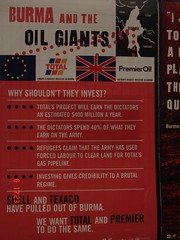 What is a corporation's role in dealing with countries whose Governments have questionable human rights? Should a corporation be singularly focused on generating shareholder value and spend its precious capital on non-core and non profit generating activities?
Is the economy that generates so much of wealth in the developed countries applicable to even countries that have no democracies or rules of law?
Is the argument to not interfere with the market forces a valid one when the former depends on the existence of democracy and rule of law?
John Ruggie answers (PDF) these in his special report to UN on Human rights.
The root cause of the business and human rights predicament today lies in the governance gaps created by globalization - between the scope and impact of economic forces and actors, and the capacity of societies to manage their adverse consequences. These governance gaps provide the permissive environment for wrongful acts by companies of all kinds without adequate sanctioning or reparation. How to narrow and ultimately bridge the gaps in relation to human rights is our fundamental challenge.
Saturday, April 26, 2008
It's a Text Book case of Market forces
Text books are expensive. I paid about $120 on the average for my new text books and did not have good experience buying used books online. The New York Times wrote an editorial on the high price of college textbooks calling it "outrageous pricing". I do appreciate the Congressional bill that will allow unb undled pricing. But more than this I do not see a need for any actions for setting prices.
Greg Mankiw, the author of my favorite Macroeconomics book that not only helped me do extremely well last semester but also gave me tools to analyze McCain's gas tax vacation, says in his blog that the Times should consider entering the market instead of editorializing sine there are no barriers to entry, t has a strong brand and it already knows how to hire writers. He concludes that Times, "would not view starting a new textbook publisher as an exceptionally profitable business opportunity"
I looked at the Market Research 2007 data on Text book publishing.
Size of new text book business: $3.4 billion, growing ~3%, slower than used book segment
Market share of top 8 players: 95%
Operating margin of top 4 players: 25.6%, 20.2%, 15.7%, 13.0% (a nice margin)
Demographic characteristic: Students buying fewer books as they share or buy more used books.
I think with such strong concentration at the top and high fragmentation at the remaining 5% it is not easy to enter the market. While the students buy the books, marketing is done to the professors who recommend the books. I wonder whether the professors rely on th e established brand name publisher than the author of the books. This creates barriers for new entrants despite the latter's established brand name in other areas.
I also think margins like 15% to 25% are extremely attractive and also tells us that the publishers are not doing this just as a service to education. The continued increase in prices despite the technology, marketing strength, outsourcing and experience curve benefits is surprising. It does leads one to wonder if there is tacit price collusion. More analysis is needed to look at specific segments each of the top players specialize in and whether they split the market among themselves to avoid competing with one another.
I would like to see no more recommended textbooks and unbundling at chapter level. Professors should pick and choose separate chapters from a variety of authors (dealing directly with them instead of publishers) and suggest a proposed electronically published course pack. This sure would solve the high price of textbooks by changing the game instead of through legislations.
 undled pricing. But more than this I do not see a need for any actions for setting prices.
Greg Mankiw, the author of my favorite Macroeconomics book that not only helped me do extremely well last semester but also gave me tools to analyze McCain's gas tax vacation, says in his blog that the Times should consider entering the market instead of editorializing sine there are no barriers to entry, t has a strong brand and it already knows how to hire writers. He concludes that Times, "would not view starting a new textbook publisher as an exceptionally profitable business opportunity"
I looked at the Market Research 2007 data on Text book publishing.
Size of new text book business: $3.4 billion, growing ~3%, slower than used book segment
Market share of top 8 players: 95%
Operating margin of top 4 players: 25.6%, 20.2%, 15.7%, 13.0% (a nice margin)
Demographic characteristic: Students buying fewer books as they share or buy more used books.
I think with such strong concentration at the top and high fragmentation at the remaining 5% it is not easy to enter the market. While the students buy the books, marketing is done to the professors who recommend the books. I wonder whether the professors rely on th
 e established brand name publisher than the author of the books. This creates barriers for new entrants despite the latter's established brand name in other areas.
I also think margins like 15% to 25% are extremely attractive and also tells us that the publishers are not doing this just as a service to education. The continued increase in prices despite the technology, marketing strength, outsourcing and experience curve benefits is surprising. It does leads one to wonder if there is tacit price collusion. More analysis is needed to look at specific segments each of the top players specialize in and whether they split the market among themselves to avoid competing with one another.
I would like to see no more recommended textbooks and unbundling at chapter level. Professors should pick and choose separate chapters from a variety of authors (dealing directly with them instead of publishers) and suggest a proposed electronically published course pack. This sure would solve the high price of textbooks by changing the game instead of through legislations.
Thursday, April 24, 2008
Slowing Restaurant Sales
 The problem with products like food and drinks and with food service business is scalability. There are only a limited number of people in the market. The current slowdown in restaurant business has its roots in how the market grew at faster rate than the population growth. National Restaurant Association says that the number of restaurants grew at a more than two times the rate of population growth during the period 1990 to 2006. The total market size increased from $239 billion (nominal) to $550 billion (nominal). This implies two stylized facts:
- The average sales per restaurant has remained constant over this period.
- An average meals consumed outside the home per person increased as well.
The current economic slowdown will lead to people cutting their additional meals outside home. An average restaurant that saw near zero growth will now see its sales drop. With increase in marginal costs due to food prices increase and the increase in operational costs, restaurants are getting squeezed from revenue side and the cost side.
For franchise owners, there is no relief from the franchise fees despite falling sales and rising costs since the franchisees pay a percentage of the sales.
For family owned and operated restaurants, the impact is going to be worse, since the costs are much higher and the operations are geographically concentrated.
This calls into the question the notion of making a comfortable living by owning a franchise or a family restaurant let alone running a business
Wednesday, April 23, 2008
Older Workers in the Minimum Wage Pool
As the US economy weakens, increasing number of adults are finding themselves in minimum wage jobs that are traditionally done by young adults. The minimum wage jobs do not pay enough for a sustainable living and these are not meant to. For an efficient labor market these wages should be cleared at the market price that matches demand with supply.
WSJ says:
The increase in supply of labor will place a downward pressure on the wages. The increasing gas and food prices will continue to make to make it difficult for these adults and unemployed college grads to sustain a living.
The problem could get worse during this summer with the June 24th minimum wage hike. Business owners grappling with increasing prices of raw materials and supplies that cannot be passed on fully to their customers cannot let their thin margins erode with a wage increase. Any artificial increase in wages when supply far exceeds the demand will cause the businesses to not hire, aggravating the situation.
The alternative is to reallocate capital from social spending projects to infrastructure projects. May be even adopt a version of McCain's tax holiday plan, except instead of giving the tax holiday to the customers use the $6 billion dollar gas tax collected over the 90 period to fund startups, invest in special education for job training and other job creation projects.
WSJ says:
Weakness in the economy is accelerating a structural shift in employment patterns. More adults, including unemployed college grads, older workers, former welfare recipients, immigrants and working adults seeking second jobs, are competing for low-skilled hourly posts.
The increase in supply of labor will place a downward pressure on the wages. The increasing gas and food prices will continue to make to make it difficult for these adults and unemployed college grads to sustain a living.
The problem could get worse during this summer with the June 24th minimum wage hike. Business owners grappling with increasing prices of raw materials and supplies that cannot be passed on fully to their customers cannot let their thin margins erode with a wage increase. Any artificial increase in wages when supply far exceeds the demand will cause the businesses to not hire, aggravating the situation.
The alternative is to reallocate capital from social spending projects to infrastructure projects. May be even adopt a version of McCain's tax holiday plan, except instead of giving the tax holiday to the customers use the $6 billion dollar gas tax collected over the 90 period to fund startups, invest in special education for job training and other job creation projects.
Wednesday, April 16, 2008
Gas Tax benefits do not trickle down
Presidential candidate John McCain called for gas tax holiday over the summer months. The idea is that reducing taxes increases the disposable income people have and will lead to higher consumer spending which leads to income growth as a function of Keynesian multiplier. McCain is correct in that this is like a fiscal stimulus which will lead to expansion.
Gas Tax is not a percentage of gas price we pay at the pump. It is fixed at 18.4 cents per gallon. According to 2007 data, US consumes 388.7 million gallons of gas a day. Rounding it to 400, this translates to a lost revenue to the Government over this tax holiday to be, $6.6 billion.
The first question to ask with any fiscal stimulus package is, "How are you doing to fund it?"
One way would be to reduce Government spending. In the election year, even the self described fiscal conservative like McCain would not agree to cut in spending. So this would be deficit funding. Right on the heels of $145 billion fiscal stimulus approved by the Congress, the additional tax reprieve will hurt the deficit.
Another important question McCain should ask is, "What is the source of the gas price increase?". Unlike previous oil price shocks the source of the current shock is the higher demand for oil from China and India. So reducing the gas tax may entice the US consumer to consume more gas, increasing the demand further and hence the price at the pumps, creating effects that are opposite of what McCain wants.
The other source of the gas price increase is the weak dollar. Since US is a net Oil importer, it has to pay more of its weak currency and that gets passed on to the consumer. An increased consumption due to gas tax holiday may funner more US dollars to the oil producing countries, there by decreasing net exports and hence shrinking the economy.
It is very easy to see that McCain and his economic team understand this and know full well this is not going to happen. They also know that the democratic candidates would come out strongly against this tax holiday. This is just a way to get political mileage with more ammunition to describe his opposition as tax happy spenders.
Gas Tax is not a percentage of gas price we pay at the pump. It is fixed at 18.4 cents per gallon. According to 2007 data, US consumes 388.7 million gallons of gas a day. Rounding it to 400, this translates to a lost revenue to the Government over this tax holiday to be, $6.6 billion.
The first question to ask with any fiscal stimulus package is, "How are you doing to fund it?"
One way would be to reduce Government spending. In the election year, even the self described fiscal conservative like McCain would not agree to cut in spending. So this would be deficit funding. Right on the heels of $145 billion fiscal stimulus approved by the Congress, the additional tax reprieve will hurt the deficit.
Another important question McCain should ask is, "What is the source of the gas price increase?". Unlike previous oil price shocks the source of the current shock is the higher demand for oil from China and India. So reducing the gas tax may entice the US consumer to consume more gas, increasing the demand further and hence the price at the pumps, creating effects that are opposite of what McCain wants.
The other source of the gas price increase is the weak dollar. Since US is a net Oil importer, it has to pay more of its weak currency and that gets passed on to the consumer. An increased consumption due to gas tax holiday may funner more US dollars to the oil producing countries, there by decreasing net exports and hence shrinking the economy.
It is very easy to see that McCain and his economic team understand this and know full well this is not going to happen. They also know that the democratic candidates would come out strongly against this tax holiday. This is just a way to get political mileage with more ammunition to describe his opposition as tax happy spenders.
Subscribe to:
Posts (Atom)