Milton Friedman said, "the business of business is business". He described the primary responsibility of the executive officers is to enrich the stakeholders by employing the capital in profitable ways. He further argued that the discussions on the need for social responsibility are "loose and lack the rigor".
I chose the case of Unocal (now part of Chevron) in Burma for my Ethics paper. I am struggling with this case, trying to reconcile my emotional side which believes CSR is a given vs. my business training which makes me want to agree with Friedman.
While I tend to agree with Friedman, I am siding with John Ruggie, Professor at Kennedy School of Government, that a corporation cannot be complicit with a despot and should not trample on human rights even indirectly.
Showing posts with label CSR. Show all posts
Showing posts with label CSR. Show all posts
Friday, May 2, 2008


Monday, April 28, 2008
Corporations and Human Rights
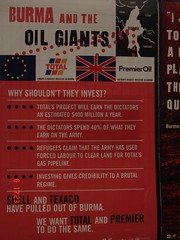 What is a corporation's role in dealing with countries whose Governments have questionable human rights? Should a corporation be singularly focused on generating shareholder value and spend its precious capital on non-core and non profit generating activities?
Is the economy that generates so much of wealth in the developed countries applicable to even countries that have no democracies or rules of law?
Is the argument to not interfere with the market forces a valid one when the former depends on the existence of democracy and rule of law?
John Ruggie answers (PDF) these in his special report to UN on Human rights.
The root cause of the business and human rights predicament today lies in the governance gaps created by globalization - between the scope and impact of economic forces and actors, and the capacity of societies to manage their adverse consequences. These governance gaps provide the permissive environment for wrongful acts by companies of all kinds without adequate sanctioning or reparation. How to narrow and ultimately bridge the gaps in relation to human rights is our fundamental challenge.
Subscribe to:
Comments (Atom)