
Tuesday, February 2, 2010


Wednesday, March 4, 2009
Sunday, December 21, 2008
Paying customers to get them on your mail list
Last week I took my car to the dealer to attend to the recall. The service manager asked if I wanted to be on their mailing list, "No spam, we will jsu send you coupons and offers". I was hesitant then I asked if they can do the oil change at a $10 discount and he immediatly agreed. This led me to thinking:
- It is possible service manager is incented to signup as many customers as possible for the mailing list and may even be incented per email. Since he is not hit with the $10 reduction in oil change fee he is more inclined to offer these discounts to sign up people. If this is the case the dealership not only does not know for building its customer mailing list but also may be acquiring cutomers with very low or negative Long Term Value (LTV).
- Perhaps the dealship always overcharges customers and only the uninformed pay the full charge. This would mean they are relying on their customers ignorance and not building a trust based relationship. If this were the case then it defeats the purpose of a mailing list, when your interactions with the customers are more transactional, you hope to capture all the value in one transaction.
Friday, December 5, 2008
Sunday, November 30, 2008
Deflation is in the minds of customers, just like Inflation
The New York Times story on Black Friday sales has this quote from a non-shopper,
At Westfield Century City Shopping Center in California, Harper Mance, 31, said: “I’m looking around, thinking, ‘If there are discounts on everything now, what’s it going to be like after Christmas?’ You know it’s going to go down further.”
Sunday, November 23, 2008
Innovation Crisis in US
"The US system of public education must lay the foundation for developing a workforce that is literate in mathematics and science, among other subjects. It is the creative intellectual energy of our workforce that will drive successful innovation and create jobs for all citizens."
Tuesday, November 18, 2008
Friday, September 5, 2008
Market Share At Any Cost
Going after market share with a low price strategy may look attractive in a competitive environment with no clear differentiation between the products. But when price is the only appealing factor, companies stand to lose value in a spiraling price war. The lure of market share is more prevalent in consumer products where companies are destroying value and commoditizing their premium brands with price cuts.
The newly appointed CEO, Paul Polman, of embattled Consumer Products maker, Unilever, has this to say about his strategy:
Mr.Polman nailed it.
The newly appointed CEO, Paul Polman, of embattled Consumer Products maker, Unilever, has this to say about his strategy:
We are not going to have a mentality to grow at the expense of othersHe was quoted as saying that he would avoid fighting for market share at any cost, a trap that lead companies to cut prices too steep or chase low-margins products.
Mr.Polman nailed it.
Monday, September 1, 2008
Randy Pausch and Randy Komisar - Trade Money For Time

 This weekend I watched the time management lecture by Randy Pausch, (well known for his terminal condition and his book The Last Lecture). I also read a book by Randy Komisar, The Monk and The Riddle. The two Randys talked about exactly the same thing.
 Their core concept is the same, simple and profound - worry about the scarcest and non-reprehensible resource. Time and not money. Both goad us to ask ourselves, " if I only had a short time to live, would I want to do what I am doing now. Is what I am doing worth my time? What is the opportunity cost?
 While Komisar is more holistic in his approach and asks " if I am doing step-1 because it has to be done so I can get to do step-2, which I love and is really what I want to do for the rest of my life, why? Why not do what I really want to do now? Why wait? Why subscribe to 'deferred life policy'?"
 He talks about 'drive' which pushes you to do things you have to do while 'passion' pulls you towards things you would rather be doing.
 While Komisar simply asked us to imagine our final days, Pausch literally had only few days to live and died recently.
Pausch gives tools and tactics to operationalize this, with specific and tionable and habit forming TODOs.
Together the two tell us to focus on our passion and how we go about achieving it.
Komisar's book also gives brief insights into how startups and VCs work, how they think about valuation from their perspectives and some funny anecdotes on life in the valley.
Saturday, August 30, 2008
Saturday, August 23, 2008
A Bottle of Ice Cold Coca Cola

 I was reading a book on Coca Cola, "The Real Thing" by Constance Hays. I realized I have not had a Coca Cola, the real thing not the diet type, for as far as I can remember. As I read about the mystique surrounding the flavor, the stories Coke built behind the flavor, and the public outcry about the new Coke I felt something missing from the story without the experience of enjoying Coca Cola.
The story about the Coke bottle, the reason for creating something is recognizable as Coke even from its fragments shows the essence of branding and capturing customer's imagination.
I now have an uncontrollable desire to drink ice cold coke, not from fountain, not from a can, not from a plastic bottle but from the original thick bottomed glass bottle. From the stories Hays tells us I feel there is something magical about this brand. Yes, it is sugar water and I would not want to drink one everyday, but I now have to taste it.
I have not had a Pepsi either for the same duration. I do want to try that as well and take the Pepsi challenge.
Saturday, August 9, 2008
Branding Transit System
In the Nokia World 2007 (Webcast), Chris Anderson of Wired gave a keynote speech on "Free". He described a scenario in which an entire subway line is made free through corporate sponsorship. Corporate sponsorship has enered public transit system, in Dubai. The WSJ talks about the city state auctioning off naming rights of the train lines and the stations.
This isn't going to be free but the Ad revenue will go on to subsidize otherwise expensive tickets. It is a clever move by the Dubai transit authorities this isn't guaranteed to work for two reasons:
This isn't going to be free but the Ad revenue will go on to subsidize otherwise expensive tickets. It is a clever move by the Dubai transit authorities this isn't guaranteed to work for two reasons:
- When you base your profit on sponsorship revenues even though your service adds value to your customers you destroying this value add. Your customers will end up valuing your service lower than they would have otherwise.
- If there are any changes in your Ad revenue you will need to compensate with increase in fees paid by travelers. As studies showed, moving from fee to free and increasing fees for an Ad subsidized service causes customer dissatisfaction. The recent example is the failed attempt by The New York Times to charge for their Op-Ed pieces through Times Select.
Wednesday, August 6, 2008
Marketers Love Parents With Daughters
From the Wall Street Journal interview with CEO of Six Flags:
I am one data point for this study.
studies show that young girls influence their parents' spending habits more than young boys do
I am one data point for this study.
Sunday, August 3, 2008
Can Brands Make You Break Out In Hives?
Brands are like people, they have personalities. Well not quite, we as consumers tend to attribute human like personalities to brand. If we are allergic to certain human personalities, can we be allergic to brands too?
 MarketPlace.org Beach Reads recommends a 2003 novel, Pattern Recognition. It was described as "the most finely observed and entertaining text on branding that's ever been written", by the reviewer Karrie Jacobs. Karrie describes the novels heroine Cayce Pollard to be "literally allergic to logos. The Michelin Man for example makes her physically ill".
 MarketPlace.org Beach Reads recommends a 2003 novel, Pattern Recognition. It was described as "the most finely observed and entertaining text on branding that's ever been written", by the reviewer Karrie Jacobs. Karrie describes the novels heroine Cayce Pollard to be "literally allergic to logos. The Michelin Man for example makes her physically ill".
While this level of brand sensitivity and reaction reads like hyperbole, there is certain truth to the emotional response. In her 1997 paper in the Journal of Marketing Research, Prof. Jennifer Aaker described five dimensions of brand personalities:
- Sincerity
- Excitement
- Competence
- Sophistication
- Ruggedness
Willingness To Pay
Imagine a store, not just any store, one that sells just Aquafina brand of standard size bottled water.
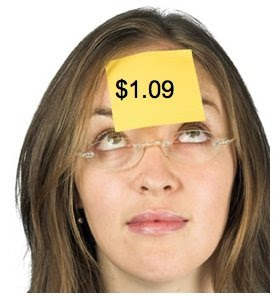 Suppose there are no price lists, no price postings anywhere in the store. You walk in to the store and pickup a bottle and walk to the cashier, who instead of scanning the barcode on the bottle scans your forehead. A LCD display flashes the price, $1.09. You pay that amount and enjoy the bottle of water.
It is you again and the same store, but a different day. You have just run 10K, practicing for Bolder Boulder race. As you walk to the cashier with the bottle, the LCD now reads $2.25. You pay as indicated.
This scenario is described as the Monopolist Dream, the Holy Grail of First Order Price Discrimination. The price that flashes on the LCD display is your Willingness To Pay. The price is not only different for different customers, but is different to you as well based on your need.
Willingness to Pay is exactly that, how much you value the product. Priced exactly at your WTP, you are indifferent to keeping the money vs paying for it. Priced even a penny above you will not buy, and anything less you get a price rent or more commonly defined as "Consumer Surplus".
For the business owner, both situations are sub-optimal, they either let you walk out with too much surplus or lose out on sales. Every business would love to get the exact WTP of every customer who walks into their store. But that is not possible, hence we need the multiple pricing models, customer segmentation and all the research that goes with it
Next time you walk into Chipotle, think why the Vegetarian Burrito is priced at $5.29? How much surplus are you getting at that price?
Source: My class notes from Microeconomics by Professor Steven Tadelis.
 Suppose there are no price lists, no price postings anywhere in the store. You walk in to the store and pickup a bottle and walk to the cashier, who instead of scanning the barcode on the bottle scans your forehead. A LCD display flashes the price, $1.09. You pay that amount and enjoy the bottle of water.
It is you again and the same store, but a different day. You have just run 10K, practicing for Bolder Boulder race. As you walk to the cashier with the bottle, the LCD now reads $2.25. You pay as indicated.
This scenario is described as the Monopolist Dream, the Holy Grail of First Order Price Discrimination. The price that flashes on the LCD display is your Willingness To Pay. The price is not only different for different customers, but is different to you as well based on your need.
Willingness to Pay is exactly that, how much you value the product. Priced exactly at your WTP, you are indifferent to keeping the money vs paying for it. Priced even a penny above you will not buy, and anything less you get a price rent or more commonly defined as "Consumer Surplus".
For the business owner, both situations are sub-optimal, they either let you walk out with too much surplus or lose out on sales. Every business would love to get the exact WTP of every customer who walks into their store. But that is not possible, hence we need the multiple pricing models, customer segmentation and all the research that goes with it
Next time you walk into Chipotle, think why the Vegetarian Burrito is priced at $5.29? How much surplus are you getting at that price?
Source: My class notes from Microeconomics by Professor Steven Tadelis.
Thursday, July 31, 2008
The Economics of Giving
I read a paper on The Economics Lives of Poor by two MIT professors of economics. I have mixed feelings. I understand the arguments at the end but I cannot roll with it.
Wednesday, July 30, 2008
What Worked For Coke Will Not Work For Dr.Pepper
A product without the messaging does not have a market. But the two are not different and interchangeable. You can't lift a successful messaging that worked for one product and apply to another. For messaging to be successful it has to start at product inception and should evolve with it.
The New York Times talks about Republicans applying the messaging that worked for Bush reelection campaign to McCain 09 campaign. The two products are basically different. A former strategist for McCain perfectly described the move to employ the previous successful team and messaging, in this way:
The New York Times talks about Republicans applying the messaging that worked for Bush reelection campaign to McCain 09 campaign. The two products are basically different. A former strategist for McCain perfectly described the move to employ the previous successful team and messaging, in this way:
“It could be the Coca-Cola strategy of marketing that they’re trying to apply to Dr Pepper,”
Sunday, July 27, 2008
Picking A MindMapping Tool
Over the past few weeks I used Windows version of MindJet and web based MindMeister.
My recommendation is to go with MindMeister.
My recommendation is to go with MindMeister.
Saturday, July 26, 2008
Crocs Valuations Wearing Out Faster Than The Sandals
 For $6, you can buy a pair of sandals that looks identical to Crocs which retails for $30. You can now buy a share of CROX stock for less than $5.
 There may be differences in how these two feel, but it is not easy to find the differences in the look. How can Crocs expect to retain its market share at such price premium? It can't.
No one can expect to defend their price premium when close substitutions are available. Add to this, the current tough economic conditions. Crocs is not going to find it easy to convince customers that value-add from its resin technology is worth the high price.
Crocs pre-warned that it will barely break even for this quarter and the outlook isn't positive for the rest of the year. It reduced its earnings forecast from 43 cents to 3 to 7 cents, at almost the same revenue levels of $220 million. Its profits are expected to drop 93% while its revenues are expected to be down only 10%.
Crocs is obviously reeling under high cost of goods sold from high oil prices and high cost of sales and marketing. But these two alone are not enough to justify such a lopsided change in operating margin. There is more hidden in its books, and this makes the stock unattractive even though it is trading close to its book value (assets less liabilities).
As I wrote last time, there are serious red flags in its accounting. It is much better off to look for other investments. In the words of Benjamin Graham, buying shares of Crocs now is not investment, it is speculation.
Subscribe to:
Posts (Atom)